

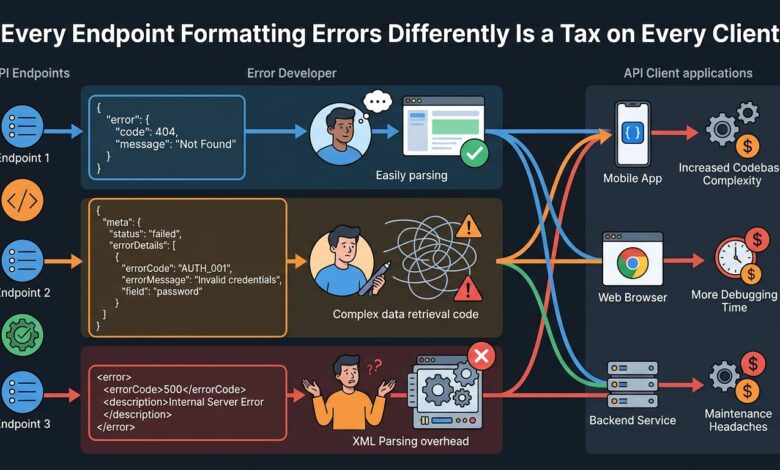
Key takeaway: Error response inconsistency is invisible to whoever built the API, because each endpoint’s error handling looked reasonable in isolation. It is highly visible to every client that has to write conditional logic to handle several different shapes for the same underlying concept.
How Inconsistency Accumulates
An API built by several people or teams over time, or even by one person across different sprints, accumulates error response variation naturally — one endpoint returns a bare string message, another returns a structured object with a code field, a third returns validation errors as an array while a fourth returns them as a keyed object, and a fifth uses HTTP status codes as the only signal with no body at all.
Each individual endpoint’s choice was reasonable when made in isolation, and nobody deliberately decided the API should have several incompatible error formats — it emerged from independent decisions made without a shared standard to check against.
The Cost This Imposes on Clients
Every client integrating with the API has to write separate handling logic for each error shape it might encounter, or write defensive code attempting to handle several possible shapes generically, which is more fragile and more code than handling one consistent shape would require. This cost is paid repeatedly by every client and every new integration, while the cost of establishing a consistent format upfront is paid once by the API’s maintainers.
| Inconsistency | Client-side cost |
|---|---|
| Some errors are bare strings, others structured objects | Type checking before accessing any field |
| Validation errors formatted differently per endpoint | Separate parsing logic per endpoint |
| Error codes present on some endpoints, absent on others | Cannot reliably branch on error type programmatically |
| Some failures signalled only by status code | Must infer meaning from status code alone, imprecisely |
The inability to reliably branch on error type is often the most damaging consequence, because a client wanting to specifically handle “this input was invalid” differently from “you are not authorised” differently from “the requested resource does not exist” needs a consistent, documented error code to branch on — inferring intent from an inconsistent mix of status codes and ad hoc messages is unreliable and breaks silently when the API’s exact wording changes.
What a Consistent Format Provides
A single error envelope structure — a stable code, a human-readable message, and where relevant a field-level breakdown for validation failures — used identically across every endpoint means a client writes one error-handling function that works everywhere, rather than one per endpoint or one defensive generic handler trying to cover every observed variant.
{
  "error": {
    "code": "VALIDATION_FAILED",
    "message": "One or more fields are invalid",
    "fields": {
      "email": "must be a valid email address",
      "age": "must be a positive integer"
    }
  }
}
The specific shape matters less than its consistency — any reasonable structure applied uniformly is far more valuable than an objectively “better” structure applied inconsistently across only some endpoints.
Retrofitting Consistency Onto an Existing API
Changing existing endpoints’ error formats is a breaking change for any client already depending on the current shape, which means retrofitting requires the same careful versioning and migration discipline as any other breaking API change — introducing the new consistent format as an additive option, giving clients a defined migration window, and only removing the old format once usage has genuinely moved to the new one.
For a new API or a new API version being introduced anyway, establishing the consistent error envelope from the outset costs comparatively little and avoids the entire retrofit problem for that version.
The Bottom Line
Define a single error response structure — code, message, optional field-level detail — and apply it identically across every endpoint from the start of any new API or API version. Treat retrofitting an inconsistent existing API with the same versioning discipline as any other breaking change, since client code is already depending on the current, inconsistent shapes whether or not that was ever the intended contract.