The N+1 Query Problem Survives Every ORM Meant to Prevent It

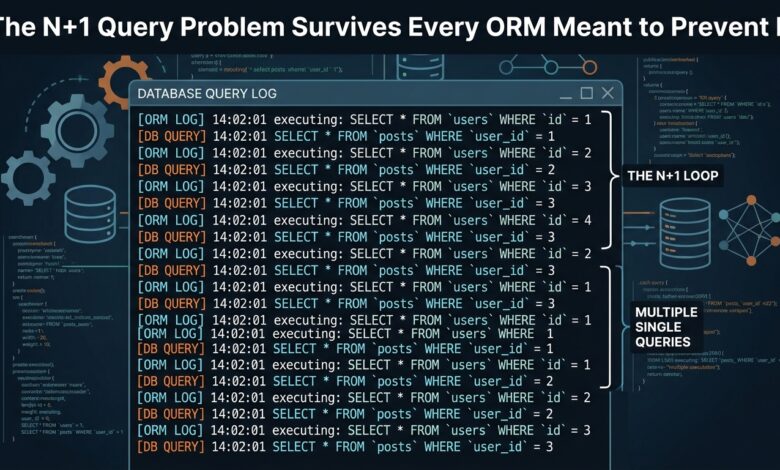
Key takeaway: An ORM makes fetching a related record for each item in a list look like one simple line of code, which is exactly what makes it easy to write an N+1 query without any indication in the code itself that a hundred separate database round trips are about to happen.
How This Pattern Is Written Without Anyone Noticing
Fetching a list of orders and then, for each order, accessing its associated customer through the ORM’s convenient relationship syntax — order.customer.name, written inside a loop over the order list — looks like accessing a property, and reads as though it should be roughly free. Under the ORM’s actual implementation, each access to order.customer that was not already loaded ahead of time triggers a separate database query to fetch that specific customer, meaning a list of a hundred orders displayed with their customer names issues one query for the order list and then a hundred additional individual queries, one per order, for the customers.
The code reads cleanly and gives no visual indication that anything expensive is happening, which is precisely why this pattern is so commonly introduced without anyone noticing during the initial development — it works correctly and looks fine with the ten test records used during development, and only becomes visibly slow once real data volume in production is large enough for a hundred extra round trips to actually matter.
Why This Specifically Scales Badly
| List size | Queries with N+1 | Queries with eager loading |
|---|---|---|
| 10 records | 11 | 2 |
| 100 records | 101 | 2 |
| 1,000 records | 1,001 | 2 |
The query count scales linearly with the list size while the eager-loaded alternative stays constant, which is exactly why this looks completely fine in development against a small dataset and becomes a serious, sometimes catastrophic performance problem once the same code runs against production data volume that nobody explicitly tested it against during development.
The Fix Most ORMs Actually Provide
Every major ORM provides an explicit eager-loading mechanism — instructing it up front to fetch the related records for the entire list in one additional query, or via a single join, rather than one separate query triggered lazily per item as each one is individually accessed during iteration.
# N+1: one query per order inside the loop
orders = Order.objects.all()
for order in orders:
    print(order.customer.name)  # separate query, once per order

# Eager loaded: fetches all needed customers up front
orders = Order.objects.select_related('customer').all()
for order in orders:
    print(order.customer.name)  # no additional query
The fix is usually a small, localised code change once identified, and the actual difficulty lies entirely in noticing the problem exists in the first place, since the buggy and the fixed version of this code look almost identical and neither one gives any visual signal in the code itself about how many actual database queries it triggers.
How to Actually Catch This
Logging or otherwise counting the actual number of database queries executed per request, in a development or staging environment specifically, surfaces this immediately and concretely — a request that should reasonably need two or three queries and is instead issuing over a hundred is an unmistakable, easily spotted signal, and this kind of check is far more reliable at catching the problem than manually reading through relationship-traversal code and trying to reason about which accesses will trigger a query.
Some ORMs and database tooling provide an explicit development-mode warning specifically for this pattern, flagging it directly during development rather than requiring it to be inferred indirectly from an elevated query count — enabling this kind of tooling where it is available removes the need to notice the problem manually at all.
Where This Extends Beyond the Obvious Case
The same underlying pattern shows up in API design too — an endpoint returning a list of items, where a separate follow-up API call is then made once per item in that list to fetch additional details for each one individually, is the identical N+1 problem at the network and API layer rather than at the database layer, and the same fix philosophy applies: batch the related fetches into one request wherever the API supports it, rather than issuing one request per item in a loop.
The Bottom Line
Enable query counting or logging in development and staging specifically to catch N+1 patterns before they reach production, since the code itself gives no visual indication of the problem and testing against small datasets will not reveal it either. Use your ORM’s explicit eager-loading mechanism wherever a list of records will have a related field accessed for every item, and watch for the identical pattern at the API layer in addition to the database layer.