
The Test Pyramid Is a Guide, Not a Law, and the Shape That Matters Is the One That Catches Bugs

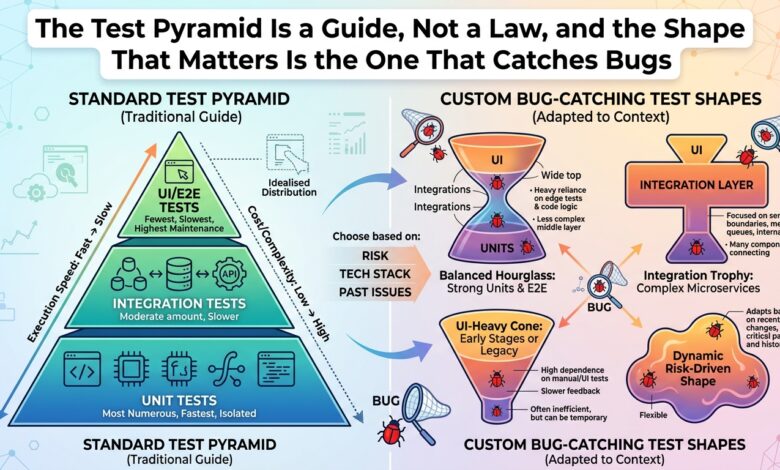
Key takeaway: The test pyramid — many unit tests, fewer integration tests, fewest end-to-end tests — is a useful heuristic, and the actual goal is a suite that catches bugs at the lowest cost, which means the right shape depends on the application and where its bugs actually live, not on a fixed prescription.
What the Pyramid Is Really Saying
The test pyramid recommends many fast, cheap unit tests at the base, fewer slower integration tests in the middle, and the fewest, slowest end-to-end tests at the top. The reasoning is sound — unit tests are fast and cheap to run and maintain, so you can have many of them, while end-to-end tests are slow and brittle, so you want few of them.
The pyramid is a heuristic for a common situation, not a law, and its real message is about cost and value — put your testing effort where it catches the most bugs for the least cost, and avoid relying on slow, brittle tests for coverage that cheaper tests could provide.
When the Pyramid Does Not Fit
The pyramid assumes that most bugs are caught by unit tests, which is true for some applications and not others. An application where the bugs live in the interactions between components — how they connect, how data flows between them, how they behave together — will find that integration tests catch more real bugs than unit tests, and the effective shape is more like a diamond or a rectangle than a pyramid.
Similarly, an application with complex user flows where the value is in the end-to-end behaviour may justify more end-to-end tests than the pyramid suggests, because those tests are the only ones that catch the bugs that actually matter for that application.
The Real Goal
The real goal is a test suite that catches the bugs that matter at the lowest cost — fast enough to run frequently, reliable enough to trust, and focused on the behaviours that actually break. The shape that achieves this depends on the application, its architecture, and where its bugs actually live, which is why the pyramid should be treated as a starting point, not a fixed requirement.
The most useful exercise is not to match a prescribed shape but to look at where the application’s real bugs come from and put the testing effort there, and to keep the suite fast and reliable enough that it is actually run and trusted.
The Bottom Line
Treat the test pyramid as a heuristic, not a law, and aim for a suite that catches the bugs that matter at the lowest cost. Put testing effort where the application’s real bugs live — more integration tests if the bugs are in component interactions, more end-to-end tests if the value is in complex user flows — and keep the suite fast and reliable enough that it is actually run and trusted, since a slow, brittle suite that nobody runs catches nothing.