
A Schema That Models the Problem Well Is Worth More Than Any Query Tuning

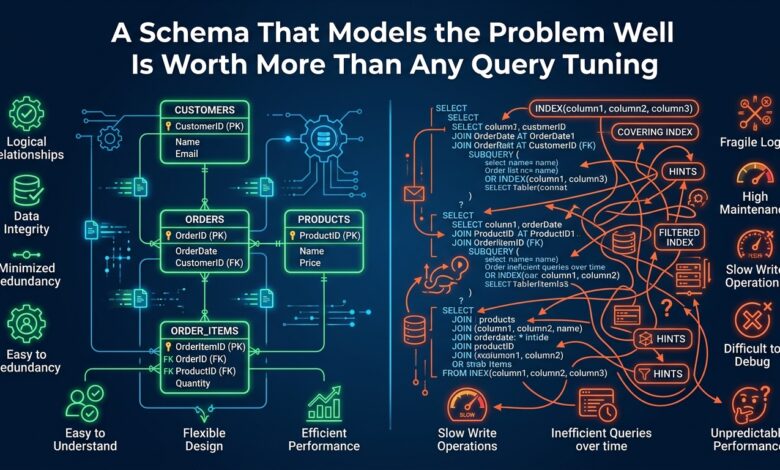
Key takeaway: Data modeling is the highest-leverage database decision, because the schema determines what queries are even possible to write simply and efficiently — a good schema makes the common queries natural and fast, while a bad one forces awkward, slow workarounds that no amount of query tuning fully fixes.
Why the Schema Matters Most
The schema defines how data is structured and related, and it determines what queries are natural to write and efficient to run. A schema that models the actual relationships in the problem well — with the right tables, the right keys, and the right relationships — makes the common queries straightforward and fast, because the structure of the data aligns with how it is actually used.
A schema that models the problem poorly — with data crammed into the wrong shape, relationships that are awkward to express, or important attributes buried where they are hard to query — makes even simple questions hard to answer, requiring complex joins, awkward filters, or application-side processing that a better schema would have made a single simple query.
The Core Modeling Decisions
| Decision | What it affects |
|---|---|
| Normalization | Whether data is stored once or duplicated |
| Primary and foreign keys | How relationships are expressed and joined |
| Whether to denormalize | Trading consistency for query simplicity |
| Data types and constraints | What the database can enforce and index |
Normalization — storing each piece of data once and expressing relationships through keys — avoids duplication and the inconsistency that duplication causes, and it is the right default for most transactional systems. Denormalization — deliberately duplicating data to make reads simpler or faster — is a deliberate trade that trades consistency and write complexity for read simplicity, and it is worth considering only where the read pattern genuinely justifies it.
The Cost of Getting It Wrong
The cost of a poor schema is not paid once at design time — it is paid continuously, in every query that is awkward to write, every join that is slow, every application workaround that compensates for a structure that does not fit the problem, and every migration that is needed to fix it later. These costs compound over the life of the system, which is why getting the schema right early is so valuable.
A schema is also much harder to change later than code is — changing the schema requires migrating existing data, updating every query and code path that touches it, and coordinating the change across the system, which is why schema mistakes are so much more expensive to fix than code mistakes.
The Practical Approach
The practical approach is to model the data around the actual relationships and the actual queries the system needs to support, starting with a well-normalized design that expresses the real structure of the problem, and denormalizing deliberately and only where a specific, measured read pattern justifies it — rather than denormalizing preemptively or normalizing without regard to how the data is actually used.
The Bottom Line
Treat data modeling as the highest-leverage database decision, since the schema determines what queries are natural and fast to write. Start with a well-normalized design that expresses the real relationships in the problem, denormalize deliberately only where a specific read pattern justifies it, and recognise that schema mistakes are far more expensive to fix later than code mistakes, which is why getting the schema right early is so valuable.