
Key takeaway: Mobile operating systems treat background work as a limited privilege, not a right — they restrict, delay, and kill background tasks to protect battery and performance, and an app that does not design around these constraints will have its background work silently delayed or terminated.
Why the OS Restricts Background Work
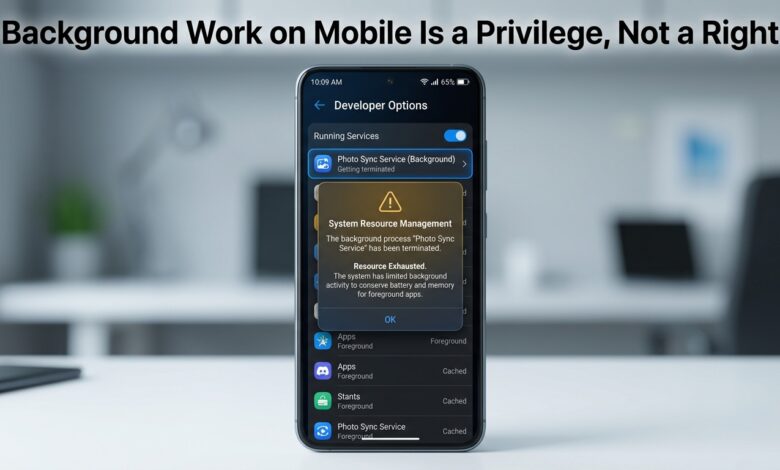
Mobile devices run on batteries, and background work consumes battery and competes with the foreground app for resources. To protect the user’s battery life and keep the device responsive, mobile operating systems aggressively restrict what apps can do in the background — limiting how long background tasks can run, delaying them, and terminating them when resources are constrained.
This is a deliberate design decision by the OS, and it means an app cannot assume it will be able to run freely in the background. A task that the app expects to complete in the background may be delayed until the app is in the foreground, or terminated partway through, and the app has to handle that.
The Constraints an App Faces
| Constraint | What it means |
|---|---|
| Time limits | Background tasks can only run for a limited time |
| Scheduling | Background work may be delayed until a convenient time |
| Termination | The OS may kill background work under resource pressure |
| Foreground priority | Work is more reliable when the app is in the foreground |
The practical consequence is that an app cannot rely on background work completing reliably. A task that takes longer than the allowed background time will be cut off, a task scheduled for the background may not run until much later, and under memory pressure the OS may terminate the app’s background work entirely.
Designing Around the Constraints
Designing around these constraints means not depending on background work to complete reliably. Long-running work should be designed to be resumable — so that if it is interrupted, it can continue from where it left off rather than starting over — and the app should not assume that background work will complete by a specific time.
It also means using the OS-provided mechanisms for background work, which are designed to work within the constraints — such as the OS’s scheduling of background tasks at convenient times — rather than trying to work around the constraints, which the OS will ultimately enforce anyway.
The Foreground Advantage
Work done while the app is in the foreground is far more reliable than background work, because the foreground app has priority and is not subject to the same restrictions. This is why the most reliable approach is to do important work while the app is in the foreground, and to treat background work as best-effort rather than guaranteed.
The Bottom Line
Design mobile apps around the reality that background work is a limited privilege, not a right — the OS restricts, delays, and terminates background tasks to protect battery and performance. Make long-running work resumable so it can continue after interruption, use the OS-provided background mechanisms rather than working around them, and treat background work as best-effort while doing important work in the foreground, where it is far more reliable.