The State Management Library Is Not the Problem; the State Design Is

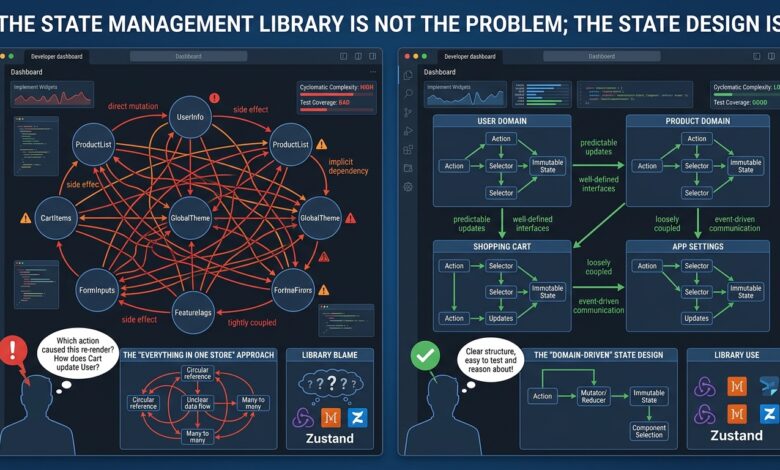
Key takeaway: The choice of state management library matters far less than how state is designed — where it lives, how it flows, and how it is kept consistent — and teams that switch libraries without fixing the underlying state design typically find the same problems in the new library.
Why Switching Libraries Does Not Fix the Problem
When an application’s state management feels messy — state scattered across components, hard to reason about, bugs from inconsistent state — the natural instinct is to blame the library and switch to a different one. The result is often disappointing, because the mess was not caused by the library; it was caused by how the state was designed, and that design carries over to the new library unchanged.
The library is a container for state, and it does not determine how the state is structured, where it lives, or how it flows through the application. Two applications using the same library can have wildly different state quality, and the same application can have the same state problems in any library, because the problems are in the design, not the container.
The Design Decisions That Actually Matter
| Decision | What it affects |
|---|---|
| Where state lives | Local component state vs. shared global state |
| How state flows | Whether data flows predictably or is passed ad hoc |
| Single source of truth | Whether the same data exists in one place or many |
| How state is updated | Whether updates are predictable and traceable |
The most important decision is where state lives — state that is only used by one component should stay local to that component, while state shared across many components needs to live somewhere they can all access it. Putting too much state in a global store, or scattering shared state across components, both create problems that no library choice fixes.
The Single Source of Truth Principle
A recurring source of state bugs is having the same data in multiple places that can get out of sync — a value stored in a global store and also copied into local component state, or duplicated across components, where one copy is updated and the others are not. The principle of a single source of truth — each piece of data lives in exactly one authoritative place, and everything else derives from it — eliminates this entire class of bug.
This is a design principle, not a library feature, and it is the kind of thing that switching libraries does not address, because it is about how the developer chooses to structure the state, not about which library holds it.
What Actually Improves State Quality
Improving state quality comes from design discipline — deciding deliberately where each piece of state lives, keeping a single source of truth, making state updates predictable and traceable, and keeping the state structure aligned with how the application actually uses it. These are habits and design decisions, and they work in any library.
A library can help by providing structure and conventions, but it cannot substitute for the design decisions, which is why the most effective change is usually not switching libraries but improving the state design within the current one.
The Bottom Line
Do not expect a state management library switch to fix state problems, since the problems are usually in the state design, not the library. Focus on the design decisions that actually matter — where state lives, keeping a single source of truth, making updates predictable, and aligning the state structure with how the application uses it — since these work in any library and are what actually determine state quality.