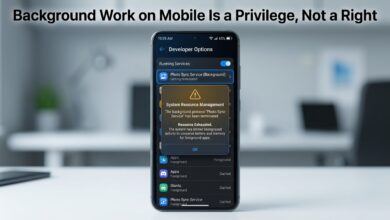
The OS Will Kill Your Background Task, and Blaming the OS Is the Wrong Response


Key takeaway: Background execution limits are not an obstacle to work around cleverly — they are the platform’s deliberate, permanent policy, and the durable solution is architecting for interruption rather than trying to outsmart the scheduler.
Why the Restrictions Exist and Keep Tightening
Early mobile operating systems allowed relatively unrestricted background execution, and applications routinely abused this to run persistent services draining battery for marginal benefit — a background sync running every few seconds regardless of whether anything actually changed, a location tracker running continuously for a feature the user rarely used. Battery life complaints traced substantially back to this behaviour.
Both major platforms responded with increasingly aggressive background execution limits over successive versions, and this trend has been consistent and one-directional for years — each platform update has generally tightened rather than loosened these restrictions, which means an app’s background approach that worked adequately on an older OS version is a reasonable candidate to break, or at minimum degrade, on a newer one, and this should be expected as an ongoing maintenance reality rather than a one-time migration.
The Common Mistake
Treating background execution limits as a bug to route around with an increasingly elaborate workaround — keeping a foreground service alive artificially, scheduling suspiciously frequent wake-ups, requesting battery optimisation exemptions unnecessarily — produces an app that works today and is fragile against the next platform update, because these workarounds are precisely the pattern the platform continues tightening restrictions specifically to prevent.
| Approach | Durability |
|---|---|
| Fight the restriction with workarounds | Fragile, breaks on next OS update |
| Foreground service for a task that is not actually foreground work | Increasingly flagged and restricted |
| Design around interruption, use platform scheduling APIs | Durable, aligned with platform direction |
| Batch and defer non-urgent work | Durable, and generally better for battery regardless |
Designing for the Restriction Rather Than Against It
Using the platform’s own background task scheduling APIs — which are specifically designed to let the operating system batch and optimise when background work actually runs, based on device state like charging status and network availability, rather than running at a time the app itself insists on — produces a more battery-efficient result than a custom scheme would achieve regardless, because the OS has visibility into device-wide conditions that a single app does not.
Structuring background work to be safely interruptible and resumable, rather than assuming a background task will run to completion once started, matches how the platform actually behaves in practice — a background task may be suspended before finishing, and the correct response is that the next scheduled opportunity resumes from a saved state, not that the app should try harder to prevent suspension from happening in the first place.
Deferring genuinely non-urgent work — analytics batching, non-critical sync, precomputation for a UI element that is not currently visible — until the app returns to the foreground, rather than insisting these run continuously in the background, avoids the whole category of restriction, because these tasks by definition do not need to run while the app is not actively being used.
What Genuinely Needs True Background Execution
Some categories legitimately need to run continuously or reliably in the background — active navigation providing real-time turn-by-turn guidance, an ongoing phone or video call, active audio playback — and both platforms provide specific, sanctioned mechanisms for these particular cases, distinct from general-purpose background execution, precisely because the platform recognises they are legitimate and different from routine background sync.
Using the correct sanctioned mechanism for the actual specific need, rather than a general-purpose foreground service claiming a category it does not truly belong to, is both more likely to continue working reliably across platform updates and less likely to be flagged as behaviour the platform is specifically trying to curtail.
The Bottom Line
Treat background execution restrictions as permanent platform policy that will continue tightening, not a temporary obstacle to engineer around. Use platform-provided scheduling APIs designed for deferrable work, structure tasks to be safely interruptible and resumable, and reserve genuine continuous background execution for the narrow, platform-sanctioned categories it was actually designed for.