
Key takeaway: Reaching for WebSockets by default for any real-time feature adds connection management complexity that server-sent events avoid entirely for the common case of server-to-client-only updates.
The Capability Mismatch
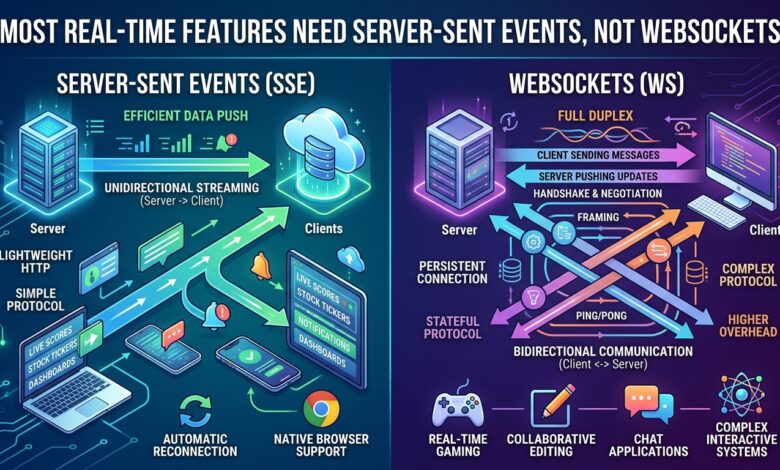
A WebSocket connection is genuinely bidirectional — either side can send a message at any time over the same persistent connection. Many real-time features do not need this: a live dashboard receiving metric updates, a notification feed, a progress indicator for a long-running job, a live score update — all of these are the server pushing information to the client, with the client never needing to send anything back over that same channel.
Using WebSockets for this is not wrong, and it is more mechanism than the problem requires, bringing along a more complex protocol, more complex server-side connection state management, and typically a heavier client-side library, for a use case that a simpler unidirectional mechanism already handles.
What Server-Sent Events Provide Instead
Server-sent events run over plain HTTP, using a long-lived connection that the server writes to as events occur, with automatic native browser reconnection built into the specification itself — no manual reconnection logic required, unlike WebSockets where reconnection handling is left to the application.
| Property | WebSockets | Server-Sent Events |
|---|---|---|
| Direction | Bidirectional | Server to client only |
| Protocol | Separate WS protocol, needs upgrade | Plain HTTP |
| Automatic reconnection | Not built in, must implement | Built into the browser natively |
| Proxy and firewall friendliness | Sometimes needs special handling | Generally works like any HTTP request |
| Appropriate for | Chat, collaborative editing, gaming | Live feeds, notifications, progress updates |
The automatic reconnection is a meaningfully underrated advantage in practice — a dropped connection due to a brief network interruption is handled transparently by the browser’s native implementation, whereas the equivalent WebSocket reconnection logic, including resuming from wherever the stream left off, has to be built and tested explicitly by the application.
When WebSockets Are Actually the Right Choice
Genuinely bidirectional, low-latency interaction — a chat application where the client also sends messages over the same channel, a collaborative document editor synchronising changes in both directions, a multiplayer game requiring frequent low-latency updates in both directions — is where WebSockets are solving the problem they were actually designed for, and server-sent events cannot substitute, since they have no mechanism for the client to send data back over the same stream.
The Decision in Practice
The test worth applying before reaching for WebSockets by default is whether the client genuinely needs to send data back over the same real-time channel, or whether ordinary request-response HTTP calls are sufficient for whatever the client needs to send, with only the server-to-client direction needing to be real-time.
If the client-to-server direction is infrequent and can reasonably be a normal HTTP request — submitting a form, triggering an action — while only the server-to-client direction needs genuine real-time push, server-sent events paired with ordinary HTTP requests for the client-initiated actions is simpler to build, simpler to operate, and avoids WebSocket-specific infrastructure concerns around load balancer configuration and connection affinity entirely.
Infrastructure Considerations
Server-sent events, being plain HTTP, generally work through standard load balancers and proxies without special configuration. WebSockets sometimes require explicit proxy and load balancer configuration to support the protocol upgrade and maintain connection affinity correctly, which is an additional operational consideration worth weighing against the actual bidirectional requirement before defaulting to WebSockets.
The Bottom Line
Default to server-sent events for real-time features that are genuinely server-to-client only, and reserve WebSockets for cases with a real bidirectional, low-latency requirement over the same channel. The automatic reconnection and simpler infrastructure requirements of server-sent events make them the lower-complexity choice for the more common one-directional case.