A Push Notification Is an Interruption, and It Should Earn the Right to Interrupt

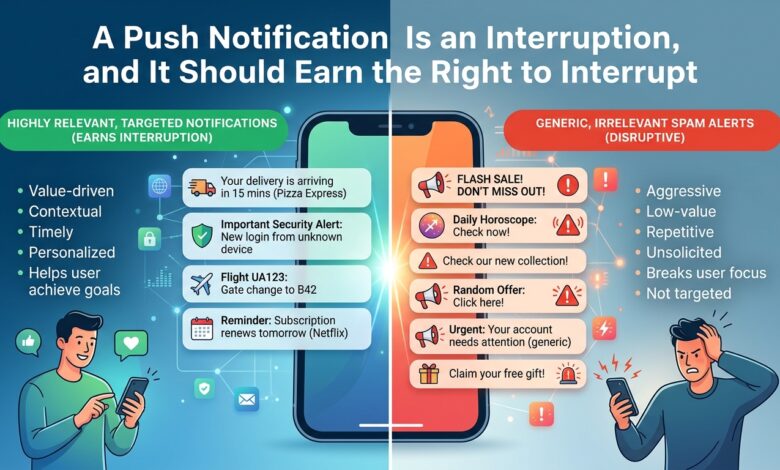
Key takeaway: A push notification is an interruption of the user’s attention, and it should earn that interruption by being relevant and timely — a notification that is not worth the interruption is not just ignored, it trains the user to ignore all notifications and can drive them to disable notifications entirely.
Why Notifications Are an Interruption
A push notification interrupts the user — it appears on their screen, makes a sound, and demands attention, regardless of what the user is doing. This is a real cost to the user, and it is why notifications should be treated as a privilege that must be earned by being worth the interruption, rather than as a free channel for the app to use freely.
The cost of a notification that is not worth the interruption is not just that it is ignored — it is that it trains the user to ignore notifications in general, and eventually to disable them entirely, which means the app loses the ability to reach the user at all, including for the notifications that would genuinely be valuable.
What Makes a Notification Worth the Interruption
| Quality | What it means |
|---|---|
| Relevance | The notification matters to this specific user |
| Timeliness | The notification arrives when it is useful |
| Actionability | The notification gives the user something to do |
| Frequency | Notifications are not so frequent they become noise |
A notification is worth the interruption when it is relevant to the specific user, arrives at a useful time, and gives the user something to act on. A notification that is generic, untimely, or frequent enough to become noise is not worth the interruption, and it erodes the user’s trust in the app’s notifications.
The Cost of Over-Notification
The most common mistake is over-notification — sending too many notifications, or notifications that are not relevant, in the hope of driving engagement. The effect is the opposite of the intent: the user becomes annoyed, learns to ignore the notifications, and eventually disables them, so the app loses the channel entirely.
This is why the discipline of restraint matters — sending fewer, more relevant notifications is more effective than sending many, because each one is more likely to be worth the interruption and the user is more likely to keep notifications enabled.
Designing Notifications Deliberately
Designing notifications deliberately means deciding what genuinely warrants an interruption — what events are important enough to the user that they would want to be interrupted — and limiting notifications to those. It also means giving the user control, so they can choose what notifications they receive, which respects the user and keeps them from disabling everything.
The Bottom Line
Treat push notifications as interruptions that must earn the right to interrupt, since a notification that is not worth the interruption trains the user to ignore all notifications and can drive them to disable notifications entirely. Send fewer, more relevant, more timely notifications rather than many, since restraint is more effective than volume, and give the user control over what they receive so they do not disable everything.