Asking for Permission at Launch Is the Single Biggest Cause of Denial

Key takeaway: The timing and context of a permission request determines the grant rate far more than the permission itself does. The same request, asked at the right moment with the right explanation, is granted far more often than the identical request asked at launch with none.
Why Launch-Time Requests Perform Badly
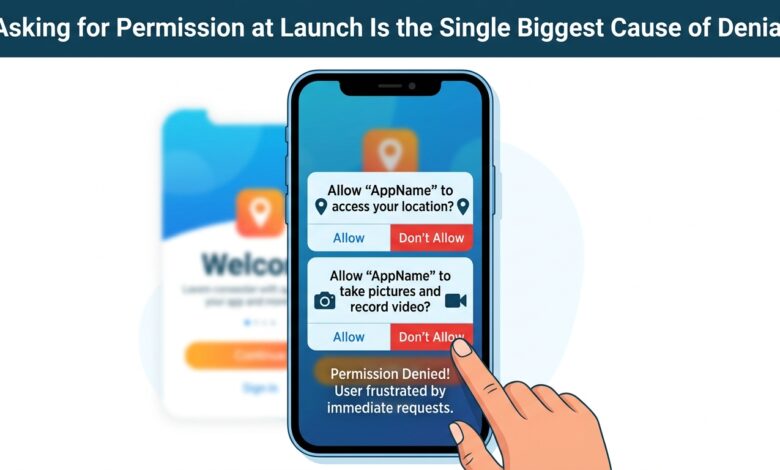
An app requesting location, camera, or notification permission the instant it opens, before the user has done anything or seen any value from the app, is asking someone to grant access based purely on trust in the app’s name and icon — with no concrete reason visible for why this specific permission is needed right now, a reflexive denial is a completely rational response from a user protecting their own privacy by default.
Critically, on both major mobile platforms, a denied permission is often harder to recover from than a delayed request would have been — a second prompt for the same permission may not even be shown again by the system after one denial, requiring the user to navigate to system settings manually to change it, which most users never do. A denial at launch is frequently a permanent denial in practice, not a temporary setback that can simply be asked again later.
What Changes the Outcome
| Request pattern | Typical outcome |
|---|---|
| Requested at launch, no context | High denial rate |
| Requested at launch, brief explanation shown first | Somewhat improved, still early |
| Requested at the moment the feature needing it is used | Meaningfully higher grant rate |
| Requested with an explanation of the specific benefit at that moment | Highest grant rate |
Requesting camera access at launch versus requesting it exactly when the user taps a “scan document” button illustrates the difference concretely — in the second case the user has just expressed clear intent to use a feature that obviously needs the camera, so the system permission prompt confirms something the user already understood and wanted, rather than asking them to trust an abstract future need they have not yet encountered.
Using a Pre-Permission Explanation Screen
Showing a custom, app-controlled explanation screen immediately before triggering the actual system permission dialog — explaining specifically why this permission is needed for the feature the user just tried to use — lets the user opt in mentally before the system’s own binary allow-or-deny prompt appears, and critically, if the user indicates through this custom screen that they are not ready, the app can choose not to trigger the actual system prompt at all, preserving the ability to ask again later without having burned the one system-level prompt that on some platforms may not reappear after a denial.
This pattern separates “explain why” from “the actual system permission decision,” which gives the app a genuine second chance to build the case for a permission that a bare system dialog with no context could not provide on its own.
Permissions That Deserve the Most Care
Location, camera, microphone, contacts and notification permissions are the ones most frequently over-requested at launch and most sensitive to this timing effect, because each has an obvious potential privacy concern in a user’s mind and each is also very commonly tied to one specific, delayable feature within the app rather than being needed for the app’s core function to work at all.
Notification permission specifically benefits from being deferred past the first session entirely in many cases — a user who has not yet experienced enough of the app’s value to want notifications about it is more likely to deny a day-one prompt than the same user asked after a few sessions of genuine engagement with the product.
The Bottom Line
Request each permission at the specific moment the feature requiring it is actually invoked, with a clear explanation of why, rather than bundling every permission into a launch-time barrage. Use a custom pre-permission screen to gauge readiness and avoid burning a limited system-level prompt on a user who is not yet convinced, and defer permissions like notifications past the very first session where reasonable.