An Upstream Field Rename Breaks Your Pipeline Silently, Not Loudly

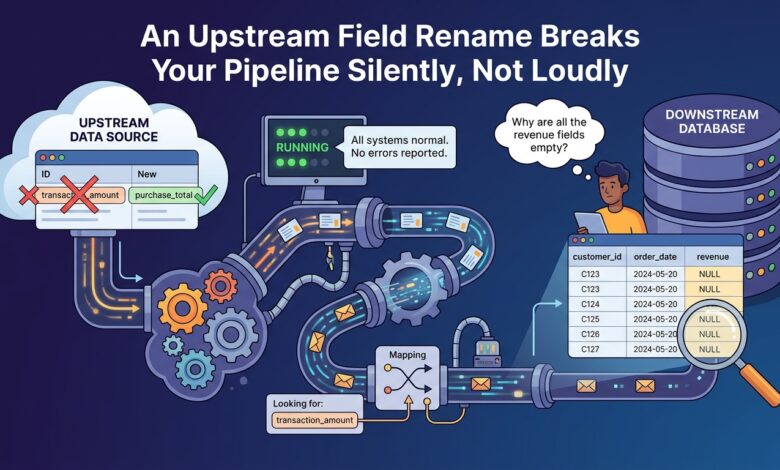
Key takeaway: Schema drift from an upstream source is one of the most common causes of silently degraded data, precisely because it produces no error — only data that is present, well-formed, and quietly wrong or absent in a way nothing flags automatically.
Why This Failure Mode Is So Quiet
A pipeline reads a field called customer_email from an upstream API or database. The upstream team renames it to email_address as part of an unrelated internal cleanup, with no coordination with downstream consumers because they may not even know the pipeline exists or what fields it depends on.
The pipeline continues running without any error, because reading a field that no longer exists under the old name typically returns null or a default rather than throwing an exception — the pipeline’s own logic was never wrong, and the upstream source’s own data is also not wrong, but the combination produces a field silently populated with nulls where real data used to flow through.
Where This Actually Gets Noticed
| Detection point | Timeliness |
|---|---|
| Automated schema validation on ingestion | Immediate |
| Data quality check on null rate per field | Within the pipeline’s own run cycle |
| Someone notices a downstream report looks wrong | Days to weeks later |
| A customer or stakeholder asks why a number seems off | Often the actual first detection point |
Relying on a human noticing a downstream report look wrong is, in practice, the most common actual detection point for this class of issue across many organisations, which is a strong argument that automated detection deserves real investment, since the alternative is silent data degradation persisting for however long it takes someone downstream to notice something looks off and trace it back.
Building Detection Into the Pipeline Itself
Schema validation at the point of ingestion — checking that every field the pipeline depends on is actually present in the incoming data, before any processing begins — converts a silent drift into an immediate, loud failure that stops the pipeline and pages someone, rather than allowing degraded data to flow through and accumulate downstream.
required_fields = {"customer_email", "order_id", "amount"}
missing = required_fields - set(incoming_record.keys())
if missing:
    raise SchemaValidationError(f"Missing expected fields: {missing}")
This is a deliberately blunt check and it is effective precisely because it is blunt — a missing field that the pipeline explicitly depends on should stop the pipeline rather than silently proceeding with null values that no downstream consumer expects.
Null rate monitoring per field, tracked over time and alerted on when a field’s null rate jumps sharply from its historical baseline, catches a related and slightly different failure mode — a field that still exists under the same name but has started receiving null values for some other upstream reason, which a presence check alone would not catch since the field is technically still there.
Coordinating With Upstream Owners
Where the upstream source is within the same organisation, establishing a lightweight contract — a documented understanding of which fields downstream consumers depend on, with a request for advance notice before any change to those specific fields — meaningfully reduces how often this occurs in the first place, though it does not eliminate the need for automated detection, since coordination inevitably fails in some cases regardless of good intentions on both sides.
Where the upstream source is external and entirely outside your control, automated detection is the only real defence available, since there is no realistic mechanism to request advance notice of an external API’s internal schema changes.
The Bottom Line
Validate expected schema at the point of ingestion and fail loudly and immediately on a missing required field, rather than allowing a pipeline to proceed with silently null data. Monitor null rate per field against its historical baseline to catch drift that does not manifest as an outright missing field, and establish an explicit field-dependency contract with internal upstream owners where that coordination is realistically possible.