Web Components Promise Framework Independence and Deliver Framework Friction

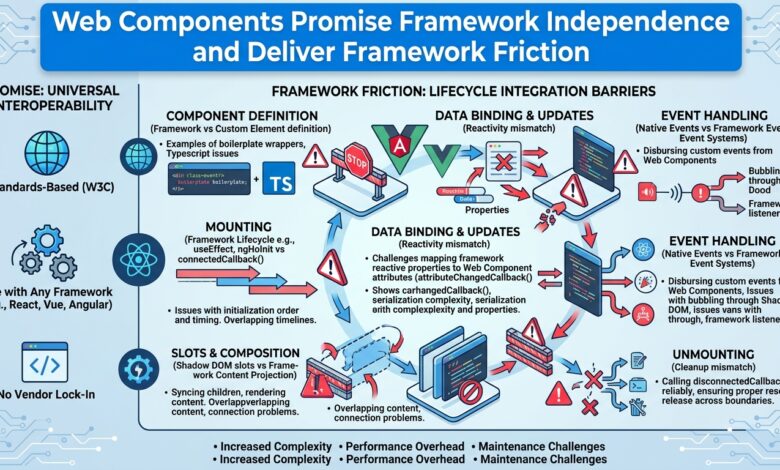
Key takeaway: Web Components solve genuine framework-independence and encapsulation problems, and the specific friction points around data passing and event handling in popular frameworks are real enough to plan around explicitly.
The Genuine Value Proposition
A custom element built with the Web Components standards runs in any framework, in plain HTML, and outlives the framework churn that eventually deprecates any framework-specific component library. This is a real and valuable property, particularly for organisations building a design system meant to be consumed across multiple internal teams that may not standardise on the same frontend framework.
Shadow DOM adds genuine style and DOM encapsulation, meaning a component’s internal styles cannot leak out and the page’s styles cannot accidentally leak in, which solves a real and recurring problem in large applications where CSS specificity conflicts between component libraries and application styles cause persistent, hard-to-debug visual bugs.
Where the Friction Actually Shows Up
| Interaction | Native HTML | Common friction in frameworks |
|---|---|---|
| Passing simple string/number attributes | Works directly | Works directly |
| Passing complex objects or arrays as props | Attributes are strings only | Requires manual property assignment, not declarative |
| Listening for custom events | Native addEventListener |
Some frameworks need explicit event binding syntax |
| Two-way data binding | Not native to custom elements | Framework-specific bridging code often required |
Passing complex data is the most consistently reported friction point. HTML attributes are fundamentally strings, so passing an array or an object to a custom element declaratively, the way JSX or a template naturally would with a plain object, does not work the same way — it typically requires imperatively setting a JavaScript property on the element reference rather than declaring it as an attribute, which breaks the declarative authoring pattern most frameworks otherwise support consistently for everything else on the page.
Custom events require similar attention. Some frameworks’ template syntax expects a specific event binding convention that does not automatically recognise a custom element’s dispatched custom events without additional explicit configuration, which is easy to overlook until an event silently fails to fire the expected handler and the debugging effort goes into that specific interop gap.
Practical Guidance for Adoption
Design the component’s public interface — its properties and events — with the awareness that complex data will likely need to be passed as JavaScript properties rather than string attributes, and document this explicitly for consumers so it is expected rather than discovered through a confusing failure.
Test the actual integration in each framework you intend to support before committing to Web Components broadly across a design system, since the specific friction points vary somewhat by framework version and the abstract standard’s promise of universal compatibility does not guarantee a frictionless experience in every consuming context.
Consider a thin framework-specific wrapper — a small adapter component in each framework that translates that framework’s natural declarative prop and event patterns into the custom element’s actual property and event interface — as a way to preserve the ergonomic authoring experience for consumers while still getting the underlying reusability and encapsulation benefit of the native component.
The Bottom Line
Adopt Web Components for design systems that genuinely need cross-framework reach and DOM encapsulation, and plan explicitly for the data-passing and event-handling friction rather than assuming standards compliance guarantees frictionless framework interop. A thin per-framework wrapper is frequently the practical answer that preserves both the underlying portability and a natural authoring experience for consumers.