
Key takeaway: A release build strips or omits debugging information for size and security reasons, which means a raw crash report from production is a list of memory addresses. Symbolication translates those addresses back into function names and line numbers, and it only works if you kept the exact matching symbol file for that specific build.
Why Raw Crash Reports Are Unreadable
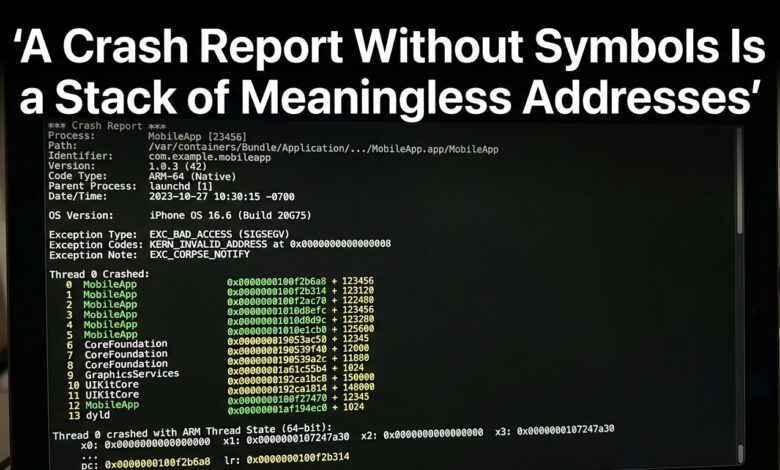
A production release build, optimised for size and to avoid exposing internal implementation details, typically strips out the debugging information that would otherwise let a crash report show human-readable function names and line numbers. What a device actually reports when a crash occurs is a stack of raw memory addresses — technically complete and, without additional information, essentially meaningless to a person trying to diagnose what went wrong.
Symbolication is the process of taking those raw addresses and mapping them back to the actual function names and source lines they correspond to, using a symbol file generated at build time that records exactly which address ranges correspond to which parts of the compiled code.
Why This Requires the Exact Matching Build
The symbol file for one build of an app is specific to that exact compiled binary — the same source code compiled again, even with no changes, can produce a binary with different internal address layouts depending on compiler version, build flags, or other build environment details, which means the symbol file from build 47 will not correctly symbolicate a crash from build 48, even if the two builds are otherwise nearly identical in source code.
| Situation | Symbolication outcome |
|---|---|
| Exact matching symbol file available | Crash report shows real function names and lines |
| Symbol file from a different build of the same version | Often produces incorrect or garbage results |
| No symbol file retained at all | Crash report remains raw addresses, unusable |
This is why crash reporting services and platform-provided pipelines emphasise automatically uploading symbol files for every single release build, rather than relying on someone remembering to keep them — a missing symbol file for one specific build number means every crash from users still running that exact build is effectively undiagnosable after the fact, with no way to retroactively generate the correct symbols once the original build environment and its exact output are gone.
Practical Discipline Around Symbol Files
Automating symbol file upload as a mandatory step in the release pipeline itself, rather than a manual step someone might skip under release-day time pressure, is the reliable way to ensure every shipped build has its crash reports remain diagnosable — a release process where this step can be silently skipped will, eventually, have a build shipped without its symbols retained, discovered only when a crash report from exactly that build turns out to be unsymbolicated and nobody can fix it after the fact.
Retaining symbol files for every released build version, not only the current one, matters because users do not all update immediately — crashes from a build released months ago can still arrive from users who have not yet updated, and if that build’s symbols were not retained or were deleted as part of some storage cleanup, those crashes become permanently undiagnosable regardless of how good the current release’s crash reporting is.
Handling Third-Party Library Crashes
A crash originating inside a third-party library or SDK your app depends on requires that library’s own symbols to fully symbolicate, which are not always available if the library ships only a compiled binary without publishing corresponding debug symbols — in this case, the app’s own code in the stack trace will symbolicate correctly while the third-party portion remains addresses, which still meaningfully narrows the investigation to whether the crash originates in your code or in a specific dependency, even without full detail on the dependency’s internals.
The Bottom Line
Automate symbol file upload as a mandatory, unskippable step in the release pipeline, and retain symbols for every released build version rather than only the most recent one, since users on older builds will continue generating crash reports that need those specific symbols to be diagnosable. A crash reporting pipeline is only as useful as the symbol file discipline behind it.